WHAT WE HELP WITH
Lead Generation & Conversion Strategy
for Home Service Businesses in DFW.
We help home service businesses fix what happens between the lead and the booked job: lead sources and cost per lead, speed to lead, estimate follow-up, sales conversion, CRM systems, and reporting. LeadLogiX identifies where leads are getting lost and which improvements deserve attention first.
We do not start by selling a tactic. We start by determining whether it makes sense for your business.
ACROSS THE GROWTH SYSTEM
Where opportunities come from and whether they are the right ones.
What happens after an inquiry—response, follow-up, and conversion.
Whether systems and workflows support how you actually operate.
How performance will be measured so changes can be judged by results.
HOW WE LOOK AT THE BUSINESS
4 Areas of Our Lead Generation Strategy
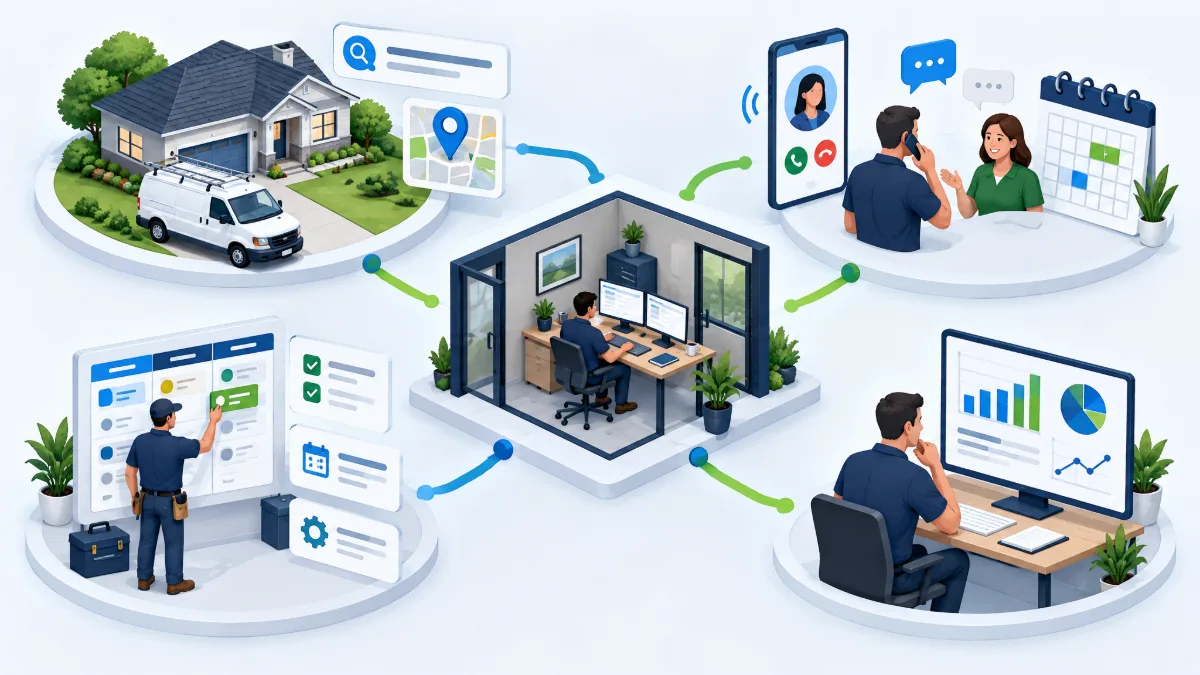
Every lead generation and conversion strategy we build is organized into four areas: attract, convert, build, and measure. These are capability groups within the LeadLogiX approach—not a fixed package. We first analyze the business and establish priorities, then determine the work that fits your goals, resources, and agreed scope.
Capability Group
Attract the Right Leads
Understand where your leads come from, what they cost, and whether your mix of lead sources, platforms, and service areas makes sense for the business.
Lead Source & Channel Strategy
We evaluate where your leads come from, your cost per lead, and which lead sources actually produce booked jobs worth keeping.
How we think about this
We look at paid, organic, referral, and platform-based sources through a simple economic lens: cost, volume, quality, and conversion. The goal is to stop guessing and see which sources are genuinely pulling their weight.
Common examples
- Lead-source evaluation and comparison
- Lead quality and fit review
- Cost-per-lead and basic economics
- Paid lead platforms and organic channels
- Referral and repeat-business paths
- Channel mix recommendations
How LeadLogiX may be involved
LeadLogiX helps interpret the numbers, recommend channel mix adjustments, and define what to test next—not automatically expand every channel at once.
Lead Platform & Territory Strategy
We help determine where a business should compete instead of assuming more territory or more leads automatically means more growth.
How we think about this
We connect lead volume, capacity, economics, and market fit so you can see which platforms and service areas deserve focus, adjustment, or restraint.
Common examples
- Lead platform review (Angi, Thumbtack, Google Local Services Ads, and other home service platforms)
- ZIP-code and service-area targeting decisions
- Territory recommendations based on economics and capacity
- Lead volume versus operational capacity
- Performance by geography or service line
- Guidance on adding, reducing, or reshaping target areas
How LeadLogiX may be involved
Depending on scope, LeadLogiX may recommend territory and platform changes, support configuration on supported platforms, or define requirements for your team or a specialist to implement.
Google Business Profile & Local Presence
We focus on the practical details of how your business appears when someone nearby searches for what you do—not abstract SEO theory.
How we think about this
Homeowners often find, compare, and call local service businesses straight from Google Search and Maps. We look at whether your profile, categories, service areas, photos, and reviews give them a clear reason to call you.
Common examples
- Google Business Profile setup and review
- Business information accuracy and consistency
- Category and service-area alignment
- Services, photos, and content guidance
- Calls-to-action and contact options
- Review strategy guidance and local presence recommendations
How LeadLogiX may be involved
LeadLogiX recommends practical updates, coordinates with whoever manages your listings, and highlights ongoing optimization opportunities. We do not promise guaranteed rankings. For background on local visibility, review Google’s guidance on improving local rankings.
Capability Group
Conversion Strategy: Turn More Leads Into Booked Jobs
Look beyond lead volume to what happens after someone reaches out—speed to lead, estimate follow-up, and how leads turn into booked jobs and revenue.
Lead Response & Speed-to-Lead
We trace what happens from the moment a lead comes in to the first real conversation, finding missed calls, slow responses, and where consistency breaks down. Why many “bad leads” are really a follow-up problem.
How we think about this
Many businesses lose good opportunities before a real conversation ever happens. We follow the path from first touch to initial contact to find the friction.
Common examples
- Inbound call, form, and text-response review
- Speed-to-lead and missed-call analysis
- Lead routing and ownership
- After-hours and weekend handling
- Initial contact scripts and workflows
- Booking and confirmation process
How LeadLogiX may be involved
LeadLogiX highlights the weak points, proposes practical changes, and helps define the workflows and responsibilities needed to respond faster and more consistently.
Sales Conversion & Estimate Follow-Up
We map how opportunities move through appointments, consultations, estimates, and follow-up so you can see where momentum is lost and what is driving your close rate.
How we think about this
Many quotes are lost to silence, not price. We look at what happens after the appointment or estimate—who follows up, how often, and through which channels—so fewer good jobs slip away.
Common examples
- Appointment and consultation process review
- Estimate and proposal follow-up paths
- Sales handoffs between roles or teams
- Nurture sequences and reminder touchpoints
- Lead disposition and reasons opportunities are lost
- Close-rate improvement opportunities
How LeadLogiX may be involved
LeadLogiX helps clarify a practical sales path that fits how you already operate, then recommends changes that improve consistency and conversion.
Website & Customer Experience
We review the digital journey for friction that may prevent interested prospects from taking the next step.
How we think about this
From first impression to form, chat, or booking, we focus on whether a real prospect can quickly understand what you do, why it matters, and how to move forward.
Common examples
- Primary website conversion paths and CTAs
- Contact forms, chat, and booking flows
- Mobile experience and page clarity
- Trust signals, proof, and service clarity
- Customer journey from click to conversation
- Conversion-focused recommendations for your web team
How LeadLogiX may be involved
LeadLogiX translates business goals into clear guidance for whoever manages your website or customer-facing tools. We stay focused on outcomes, not design trends.
Capability Group
Build the CRM & Systems Around Them
Make sure your CRM, tools, workflows, and handoffs support how you actually sell and service customers day to day.
CRM, Workflow & Automation
We help define the workflows and supporting tools needed to keep opportunities from disappearing between systems, inboxes, people, or processes.
How we think about this
The goal is not more software for its own sake. It is a clearer path from inquiry to outcome with fewer dropped balls and less dependence on memory.
Common examples
- CRM structure and pipeline design
- Lead routing and ownership rules
- Stage definitions and internal handoffs
- Follow-up workflows and tasking
- Automation opportunities and guardrails
- Integration and data-consistency requirements
How LeadLogiX may be involved
LeadLogiX defines what the system needs to do, then supports implementation by your team, a specialist, or selected vendors depending on the engagement.
AI & Customer Engagement Technology
We evaluate where emerging technology can improve response, communication, or efficiency without adding tools simply for technology’s sake.
How we think about this
We look at AI and automation through a practical lens: does it help you respond faster, communicate more clearly, or reduce manual effort in a way that fits your business and customers?
Common examples
- Opportunities for AI-assisted response or routing
- Website chat and messaging options
- Automated follow-up and reminders
- Scheduling and confirmation workflows
- Lead qualification support
- Appropriate human handoff points
How LeadLogiX may be involved
LeadLogiX helps assess whether AI or automation is a fit, define realistic use cases, and outline requirements for implementation. If it does not make sense for the business, it does not go into the plan.
Capability Group
Measure, Execute & Improve
Connect strategy to accountable work, make performance easier to read, and let real results guide what happens next.
Measurement & Reporting
We make performance easier to understand so decisions can be based on business outcomes rather than impressions, clicks, or assumptions.
How we think about this
We focus on a short list of metrics owners and operators can actually use—tying acquisition, conversion, and revenue back to specific efforts where the data allows.
Common examples
- Lead volume and conversion analysis
- Cost-per-lead and cost-per-acquisition
- Channel and campaign comparisons
- Basic funnel and economics views
- Operational metrics tied to growth
- Simple dashboards or scorecards
How LeadLogiX may be involved
LeadLogiX helps define what should be measured, how often, and where the data should live so you can quickly see what is paying off and what is not.
Execution & Implementation Support
When the strategy identifies work that needs to happen, we help establish the execution path and clarify who should own it.
How we think about this
Some work is best led by LeadLogiX. Some is better owned by your team, a shared effort, or a specialist. The important part is that every priority has a clear owner and definition of done.
Common examples
- LeadLogiX-led execution where included in scope
- LeadLogiX-assisted client or vendor execution
- Client-led implementation with clear expectations
- Collaborative work across teams and specialists
- Specialist-led work with defined requirements
- Accountability and simple progress tracking
How LeadLogiX may be involved
LeadLogiX does not claim to perform every specialist task internally. The X execution layer focuses on defining and coordinating the right ownership path for each recommendation.
Optimization & Scale
We use actual performance to determine what should be strengthened, changed, expanded, or stopped.
How we think about this
Instead of locking into a fixed plan, we let results guide the next move—deciding what to scale, what to refine, and what to retire.
Common examples
- Performance reviews against expectations
- Testing and iteration cycles
- Budget and channel allocation decisions
- Scale, watch, or pivot decisions
- Next-step prioritization based on results
- Guardrails for future expansion
How LeadLogiX may be involved
LeadLogiX helps compare outcomes with the original objectives so growth decisions stay grounded in what is actually happening, not wishful thinking.
Turn Findings Into a Practical Plan
Your conversion strategy should explain what to address, why it matters, and the suggested order of action. See how our consulting process works and explore the Strategic Growth & Execution Blueprint, your written growth plan. Implementation support through The X is scoped separately where appropriate.
THE RIGHT FIT STARTS WITH THE RIGHT QUESTIONS
Start With Your Business. Set Clear Growth Priorities.
You do not need to diagnose the problem before talking with us. You may know exactly what needs attention—or simply know the business should be performing better than it is.
A free, 30-minute consultation helps us understand your goals and challenges. If we agree to move forward, your lead generation and conversion strategy is shaped by the evidence and the scope we establish together.
YOUR BUSINESS
Where you are today.
YOUR PRIORITIES
What you are trying to improve.
THE NEXT QUESTION
Where deeper analysis may create value.
30 minutes • Free • No obligation